Platform Engineering — Internal Dev Platform
Platform Engineering
Your Internal Developer Platform — ready to use
Platform Engineering is about building golden paths that let developers self-serve infrastructure without becoming infrastructure experts. LayerOps gives you an Internal Developer Platform out of the box — no need to assemble Kubernetes, Terraform, ArgoCD and Backstage yourself.
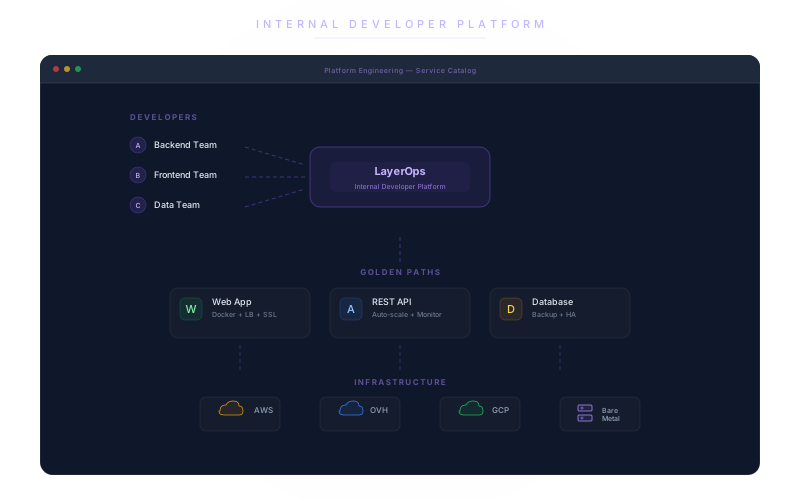
Internal Developer Platform.
Stop building your IDP from scratch
Most companies spend 12–18 months assembling an Internal Developer Platform from open-source components — Kubernetes, Terraform, ArgoCD, Backstage, Prometheus, cert-manager, and dozens of glue scripts. LayerOps replaces that entire stack with a single managed platform. Your platform team ships golden paths in days, not quarters.
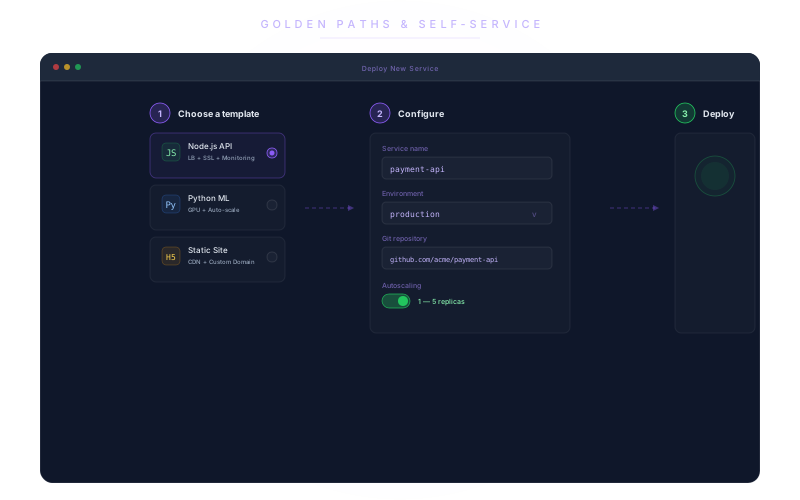
Golden Paths.
Self-service deployment in minutes
Define reusable service templates that encode your organization's best practices — infrastructure, security, monitoring, and scaling rules included. Developers pick a template, connect their Git repository, and deploy. No Helm charts, no Terraform modules, no tickets to the ops team.
What is Platform Engineering?
Platform Engineering is the discipline of building and maintaining an Internal Developer Platform (IDP) — a self-service layer that abstracts away infrastructure complexity. Instead of every team reinventing deployment pipelines, the platform team builds golden paths: opinionated, pre-configured workflows that let developers ship code to production safely and autonomously.
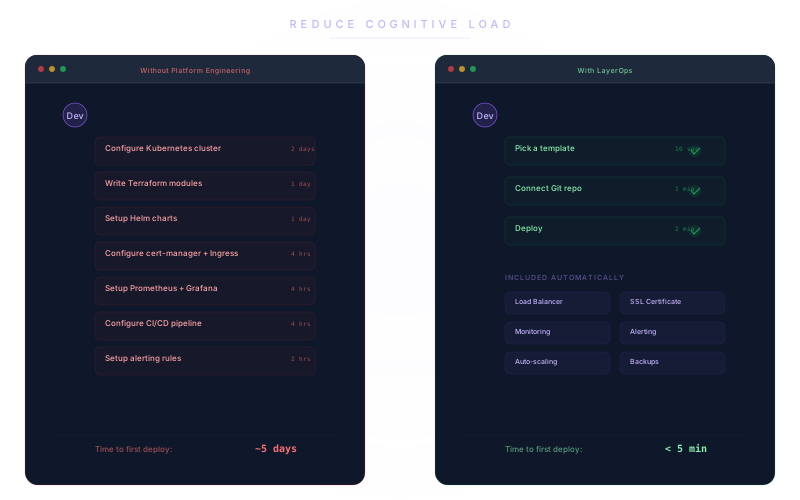
Reduce Cognitive Load.
From 5 days to 5 minutes
Without a platform, developers juggle Kubernetes manifests, Terraform state, Helm values, Ingress rules, and monitoring configs. With LayerOps, they focus on code. The platform handles load balancing, SSL, auto-scaling, monitoring, alerting and backups — automatically, on every deployment.
Why LayerOps for Platform Engineering?
Ready in hours, not months
Traditional IDPs take 12–18 months to build and require a dedicated platform team of 3–5 engineers. LayerOps gives you a production-ready IDP out of the box. Start building golden paths on day one.
Service templates as golden paths
Create reusable templates that bundle infrastructure, security policies, scaling rules and monitoring. Developers self-serve from a governed catalog — no more tickets, no more waiting.
Multi-cloud by default
Your golden paths work across AWS, GCP, Azure, OVHcloud, Scaleway and bare-metal servers. Developers don't need to know which cloud runs their service — the platform decides based on your rules.
Security baked in
Every golden path includes automatic SSL certificates, RBAC-based environment isolation, and security policies defined by the platform team. Developers can't deploy insecurely — the platform enforces your standards.
Observability included
Built-in Grafana dashboards, custom alerts, and cost analytics on every service — without configuring Prometheus, Alertmanager, or Loki. Your platform team defines monitoring standards once, and every deployment inherits them.
API-first & CI/CD ready
Integrate LayerOps into your existing CI/CD pipelines via REST API or YAML definitions. The platform becomes a programmable layer your teams extend — not a walled garden they work around.
AI-powered operations
The LayerOps MCP Server lets developers interact with the platform using natural language from any AI assistant. Deploy, monitor, scale — without leaving the IDE.
RBAC & multi-tenancy
Isolate environments per team, project or business unit. Define precise permissions on resources through role-based access control. The platform team governs, developers self-serve.
No vendor lock-in
Your services run as standard Docker containers. Export to Docker Compose or Kubernetes at any time. Platform Engineering should reduce lock-in, not create it.
Platform Engineering vs. traditional DevOps
DevOps brought developers and operations closer. Platform Engineering goes further — it turns infrastructure into a product that developers consume through self-service interfaces.
| Traditional DevOps | LayerOps | |
|---|---|---|
| Developer ExperienceDeploy a new service | File a ticket, wait for ops | Self-serve from template catalog |
| Time to first deployment | Days to weeks | Under 10 minutes |
| Infrastructure knowledge required | Kubernetes, Terraform, Helm, CI/CD | Pick a template, connect Git |
| Cognitive load on developers | High — 10+ tools to learn | Low — single platform |
| Platform TeamBuild time for the platform | 12–18 months | Hours to days |
| Engineers required | 3–5 dedicated platform engineers | 1 engineer part-time |
| Maintenance overhead | Continuous (upgrades, patches, drift) | Managed by LayerOps |
| CapabilitiesMulti-cloud orchestration | DIY (Federation, Crossplane) | Native — single pane of glass |
| Monitoring & alerting | Assemble Prometheus + Grafana + Loki | Built-in |
| Auto-scaling | HPA + Cluster Autoscaler (per provider) | Built-in, cross-provider |
| Load balancer + SSL | Ingress + cert-manager | Built-in, automatic |
| Cost visibility | Kubecost / OpenCost (add-on) | Built-in per-environment analytics |
Who benefits from Platform Engineering?
Development Teams
Ship faster with self-service golden paths. No more waiting on ops tickets. Focus on building features, not configuring infrastructure.
Platform Teams
Build and maintain golden paths in a fraction of the time. Standardize deployments across the organization. Spend time on high-value platform work, not on repetitive provisioning.
CTOs & Engineering Leaders
Reduce infrastructure costs, accelerate time-to-market, and decrease developer onboarding time. Platform Engineering is a proven multiplier for engineering velocity.
Start your Platform Engineering journey
You don't need a 12-month roadmap to adopt Platform Engineering. LayerOps gives you a production-ready Internal Developer Platform today.
Need to deploy on your own infrastructure? Discover LayerOps On-Premise — self-hosted, sovereign, with full white-label and service catalog.